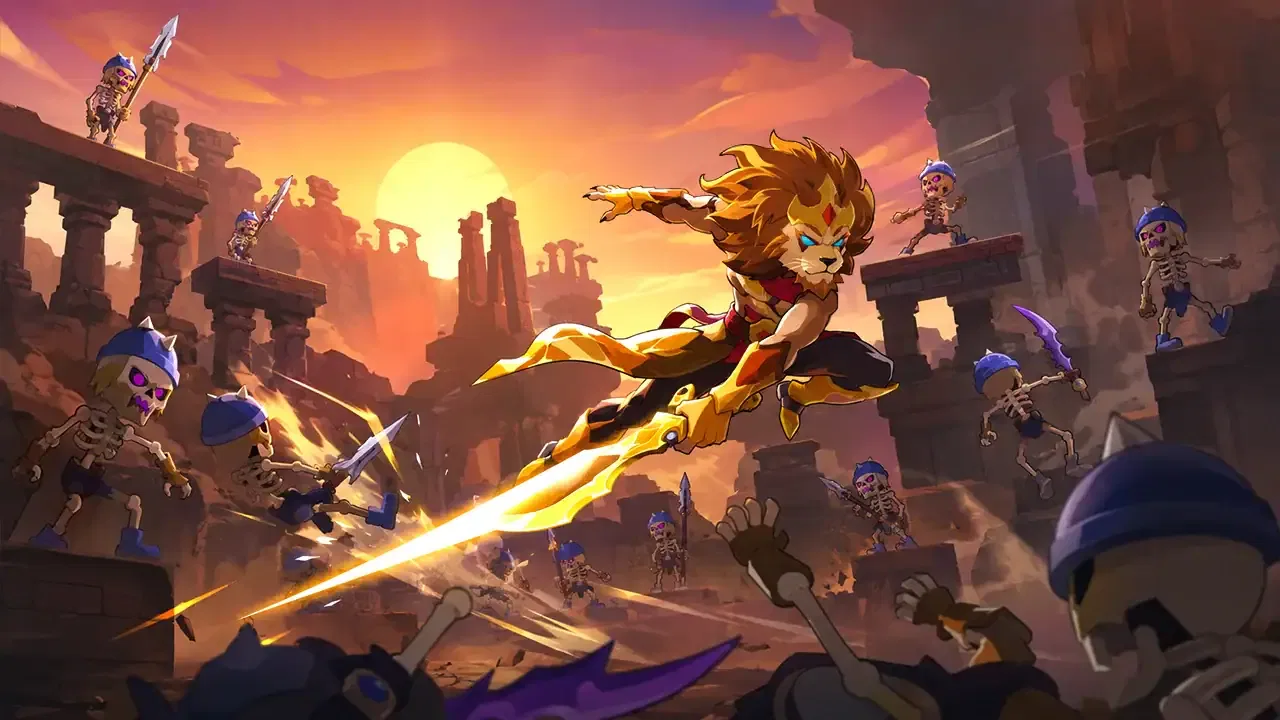
Samurai Dash-Fast Hit
- 3.3
- Rating
- 10.00M
- Installs
- Free
- Price

 Analysis by App-foxy
Samurai Dash-Fast Hit is a free arcade game from Philip Fowler Labs built around a very simple rule: mistakes are costly, and a single successful strike can decide the encounter. I found that its appeal comes less from a large menu of systems and more from the tension created by short, focused attempts. You are not juggling a complicated inventory or learning a long story. You are watching, reacting, and trying to make the next run cleaner than the last one.
That narrow focus makes it easy to understand within moments, but it also sets a clear limit on who will enjoy it. Players looking for a relaxed samurai adventure, deep character building, or a long narrative campaign should look elsewhere. Players who like compact arcade sessions and the satisfaction of improving through repeated attempts will find a more suitable experience here. The game is listed for Teen audiences, and its one-hit combat premise gives the action a sharper edge than a casual tap game.
How the first few runs establish the goal
The opening goal is refreshingly direct: stay alive long enough to land the right hit. Because the central combat idea is so easy to grasp, I never felt buried under tutorials or explanations. The first attempts are mainly about learning the rhythm of the screen, understanding when an opening appears, and accepting that rushing usually creates a bad result. That immediate clarity is one of the game’s strongest qualities.
You May Also Like

 Blood Strike: 2.5 Anniversary
Blood Strike’s Loadouts Turn Every Drop Into a Tactical Gamble
A close look at Blood Strike’s custom loadouts: how fast access to signature weapons reshapes its battle royale rhythm, rewards preparation, and narrows the gap between fights.

 Pandora - Music & Podcasts
Pandora’s Music Is Easy to Start, but Harder to Recover
Pandora’s strength is its low-effort path from a seed to a station. Its weak spot is how much confidence it asks you to place in connection, setup, and quiet recovery.

 8 Ball Pool
 Is Built on Rivalries, Rematches, and Routine
A close look at the rivalries, rematches, shared routines, and unanswered safety questions that turn a quick pool match into a persistent mobile community.

 Samsung Music
’s Quiet Strength Is Playing What You Already Own
Its reach comes less from spectacle than from dependable access to a personal library. That simplicity is both the app’s strongest retention engine and its ceiling.

 AccuWeather: Weather Radar
AccuWeather Review: A Quick, Clear Forecast for Everyday Decisions
For everyday plans, the best forecast is the one you can understand quickly. AccuWeather makes rain timing, radar, and local conditions easy to act on, with a few trade-offs.

 Hill Climb Racing
Why Hill Climb Racing Still Turns Crashes Into One More Run
A tiny car, a bumpy hill and one more upgrade: Hill Climb Racing keeps resurfacing because its simple chaos makes every near-miss feel personal.
More From Our News Desk



At the same time, the simplicity means the game has to earn your attention through execution. There is no need to spend time choosing a build before playing, and there is no broad set of objectives competing for focus. Each attempt asks the same basic question: can I read the situation correctly this time? That makes the early goal useful for short breaks, especially when I want something I can start and understand without preparation.
The one-hit premise changes how I approach even a brief session. In a typical arcade game, I might accept a few careless collisions while learning the controls. Here, every error feels more final. I began paying attention to timing rather than treating the opening minutes as disposable practice. That gives the first encounters a meaningful sense of danger, although players who dislike restarting may find the design unforgiving from the beginning.
A practical way to approach the early game is to resist the urge to play quickly. I found more value in watching the movement pattern first and treating the initial attempt as reconnaissance. Once I understood the pace of an encounter, I could focus on the moment that actually mattered instead of reacting to every visual change. This is a small but important shift: the game rewards observation before speed.
The arcade format also makes the game easy to fit around ordinary routines. I could imagine playing it while waiting for transport, taking a short break between tasks, or using a few attempts to reset after a demanding piece of work. It does not ask me to remember a complicated quest or return at a precise point in a story. The trade-off is that a quick session can end abruptly, so it is better suited to players who enjoy retrying than to anyone seeking a calm, uninterrupted play period.
What progress feels like when the rules stay simple
Samurai Dash-Fast Hit communicates progress mainly through performance. A cleaner reaction, a better read of an opponent, or a longer sequence of successful decisions becomes its own reward. I noticed that the most satisfying improvement was not simply reaching a later point; it was realizing that a situation that once felt random had become understandable. The game turns familiarity into a form of advancement.
That approach will appeal to players who enjoy mastery-based arcade games. Instead of depending on a large collection of upgrades, the experience asks me to improve my judgment. The benefit is that progress feels personal and immediate. The weakness is that players who need visible unlocks, equipment changes, or a constantly expanding set of activities may feel that their effort is not being acknowledged enough.
The game’s presentation of progress is therefore best understood as a test of consistency. One successful action can be exciting, but repeating that success under pressure is where the real challenge begins. I found myself setting small personal targets: survive one more exchange, avoid the mistake that ended the previous run, or reach the same point with less hesitation. These goals are modest, yet they give short sessions a useful direction.
There is also a subtle difference between learning the game and merely memorizing it. If I react only to a familiar sequence, a small change in timing can expose the weakness in my approach. The better habit is to read what is happening in the moment. That makes the experience more demanding, but it also prevents the action from becoming completely automatic. For players who enjoy pattern recognition, this is a meaningful strength.
One useful workflow is to separate practice from score chasing. In the first few attempts, I concentrate on identifying the timing window and ignore whether the run looks impressive. After that, I try to repeat the same action without overcorrecting. This prevents the common arcade mistake of changing too many things after one failure. The game does not need a complex training mode for this approach to work; the short retry cycle itself supports it.
Where the difficulty curve becomes the real content
The difficulty is most interesting when the game stops feeling like a reaction test and starts testing patience. A fast response can be valuable, but a premature response is still a mistake. I had to learn that the safest action is not always the quickest one. That tension gives the combat more character than the minimal premise might suggest.
Because failure carries such a heavy consequence, the curve can feel steep even when the individual actions are easy to understand. New players may interpret an early defeat as evidence that they lack reflexes, when the actual issue may be hesitation, poor attention, or acting before the opening is clear. I would recommend playing with the sound and visual distractions around you reduced, because concentration matters more here than frantic input.
The game is at its best when it creates a narrow space between caution and aggression. Waiting too long can be just as uncomfortable as attacking too early, and the pressure comes from having to choose without complete certainty. That is the kind of difficulty I appreciate in an arcade title: not complexity for its own sake, but a demand for better decisions.
Still, this design has a natural ceiling. If the challenge relies primarily on repeating the same fundamental interaction, some players will eventually feel that they have learned the lesson and are only being asked to perform it again. The experience is strongest for people who enjoy polishing a skill. It is less convincing for players who expect each stage to introduce a dramatically different way to play.
My advice is to judge the difficulty by asking whether failure teaches you something. If a lost attempt reveals that you attacked too early or ignored a useful visual cue, the retry has value. If you feel that the outcome was unreadable, frustration arrives much faster. Taking a short pause after a failed run helps; immediately tapping through another attempt while annoyed usually makes the same mistake more likely.
How goals and pacing keep the short sessions moving
The pacing depends on quick restarts and the desire to correct the last error. That structure creates a strong loop for players who enjoy “one more try” sessions. I often found that a defeat did not feel like a reason to stop immediately; it felt like a prompt to test one adjustment. The danger is that this same loop can become repetitive if the player is not personally invested in improving.
There is no need to wait through a long setup before reaching the meaningful part of an attempt. That is important for a mobile arcade game because it respects short bursts of attention. I can play for a few minutes, stop, and return without needing to reconstruct a complicated situation. The pacing is economical, and the central action remains easy to find.
However, the lack of a broader goal may create retention pressure in a different way. The game can hold me through challenge, but not necessarily through variety. If I am motivated by personal bests and cleaner execution, that is enough. If I need a story beat, a collection objective, or a visible long-term project, the repeated duel-like structure may not sustain interest for as long.
This is where the game differs from many other arcade alternatives. A conventional endless runner often keeps attention through constant movement, changing obstacles, and the urge to extend a distance. Samurai Dash-Fast Hit feels more deliberate: its tension comes from deciding when to commit rather than from continuously avoiding everything on screen. On the other hand, a larger action game may offer richer progression and more varied encounters, while this title offers a faster route to its central idea.
I would also compare it with reaction-based mini-games that rely on rapid tapping. Those alternatives can feel more immediately energetic, but they may not create the same sense of consequence. Here, the one-hit structure makes a successful decision feel more important. The trade-off is that a player who wants constant input may find the waiting and reading phase too restrained.
Who will enjoy the challenge and who should skip it
I would recommend this game to someone who likes arcade mechanics that are easy to explain but difficult to perform consistently. It suits players who enjoy testing reflexes, recognizing patterns, and turning failure into a small lesson. It is also a good match for anyone who prefers short sessions over a large mobile game that demands a long commitment each time it opens.
I would be more cautious recommending it to someone who wants a relaxing samurai fantasy. The theme suggests speed and style, but the actual experience is built around pressure. It is not the right choice if you dislike restarting, want generous health, or prefer to win through equipment upgrades rather than personal timing. A more expansive action game would be a better fit for those expectations.
The Teen content rating is worth keeping in mind for families choosing games for younger players. The game’s premise is centered on decisive combat, so it does not present itself as a purely gentle puzzle or family arcade experience. For an adult or older teen who understands the format, that sharpness is part of the appeal rather than a problem.
It is also worth considering the free price in practical terms. Since there is no purchase cost to begin, the easiest way to evaluate the game is to give it a focused session rather than judging it from screenshots or its short description. If the first several attempts make you curious about improving, the core loop is probably working for you. If the repeated one-hit failures feel irritating immediately, no amount of extra time is likely to change the basic character of the game.
Technical fit and what the version tells me
The game supports devices running Android 8.0 or later, which makes it accessible to a broad range of Android users. Its current version is 1.9.14, and the title has been available since January 11, 2024. Those details matter mainly because they help set expectations: this is an established mobile release rather than something I would approach as an unfinished experiment.
Its reach is also substantial, with over ten million installs, while the average rating sits at 3.3 from around two thousand eight hundred ratings and one hundred sixty-seven reviews. I read that combination as a sign of a game with a clear audience but uneven appeal. Many people have tried it, yet the middling average suggests that the strict format and limited central loop will not work equally well for everyone.
That is consistent with my experience. When the timing feels readable, the game is satisfying and clean. When I am not in the mood to concentrate, the same design can feel abrupt and repetitive. The rating makes more sense when viewed through that lens: this is not trying to please every mobile player, and its strongest qualities are tied directly to the features that may frustrate a different audience.
Philip Fowler Labs has kept the identity of the game focused rather than turning it into a crowded all-purpose action app. I appreciate that restraint, but it also means the title has less room to hide weaknesses. In a larger game, a disappointing encounter might be balanced by exploration, customization, or story. Here, the quality of the timing challenge carries most of the experience.
My verdict on the progression loop
Samurai Dash-Fast Hit succeeds when progression is measured by the player’s growing control. The early goals are clear, the feedback comes quickly, and the difficulty encourages careful observation instead of random button pressing. I especially like the way a short attempt can still produce a useful lesson, making the game easy to fit into a busy day without making every session feel meaningless.
Its limitations are equally clear. The one-hit structure can be harsh, and the narrow arcade loop may not provide enough variety for players who need frequent new systems or a strong long-term reward path. The pacing is excellent for quick retries, but it does not automatically create lasting motivation. Retention depends heavily on whether you personally enjoy refining timing and chasing a cleaner performance.
The best reason to play is the feeling of turning one careful decision into a successful run. I would install it if I wanted a free, focused arcade challenge that I could pick up for a few minutes and gradually improve at. I would skip it in favor of a broader samurai or action game if my priority were exploration, customization, narrative, or forgiving combat.
Overall, I see Samurai Dash-Fast Hit as a specialized arcade experience rather than an all-purpose mobile game. It does not need a complicated progression system to be engaging, but it does need the player to enjoy its strict rules. If that one-hit tension sounds motivating rather than punishing, the game offers a compact and honest test of timing. If it sounds exhausting, the free download is still easy to pass up, because its focused design leaves little doubt about what kind of player it is built for.
For me, the final recommendation is positive but specific: try it when you want concentrated action, approach each attempt as practice, and do not expect the game to transform into a larger adventure later. Its value is in the precision of the core loop. Once that clicks, even a brief session can feel rewarding; when it does not, the same simplicity becomes the reason to move on.
FAQs for Samurai Dash-Fast Hit
01What is Samurai Dash-Fast Hit?
Samurai Dash-Fast Hit is an action game focused on quick reflexes, fast movement, and close-range combat. Players control a samurai who runs through dangerous environments while avoiding obstacles and defeating enemies with rapid attacks. The gameplay is designed for short sessions, making it suitable for casual play, although the increasing speed and enemy patterns can make later stages considerably more challenging.
02How do you play Samurai Dash-Fast Hit?
The game relies on simple touch controls, so it is easy to start playing without a long tutorial. You generally guide the samurai through the level, time movements carefully, avoid hazards, and attack opponents at the right moment. Success depends less on complicated combinations and more on reaction speed, accurate timing, and learning how enemies and obstacles behave during each run.
03Is Samurai Dash-Fast Hit free to download and play?
Samurai Dash-Fast Hit can generally be downloaded at no initial cost, but availability and monetization may vary depending on the Android or iOS version and your region. As with many free mobile games, players should check the store listing for advertisements, optional purchases, energy systems, or other limitations. Reviewing those details before installation is recommended, especially if the game will be used by children.
04Does Samurai Dash-Fast Hit require an internet connection?
The basic action may work offline if the installed version stores its levels and progress locally, which is convenient for playing while traveling or when mobile data is unavailable. However, an internet connection may still be required for advertisements, updates, synchronization, purchases, rankings, or other online features. It is best to test the game in airplane mode after installation rather than assuming every feature will function offline.
05Is Samurai Dash-Fast Hit suitable for all players?
The game is a good choice for players who enjoy fast arcade action, samurai themes, and short challenges based on reflexes. Its controls are approachable, but the rapid pace can become demanding, particularly for younger players or anyone who prefers relaxed gameplay. Before downloading, check the official age rating, privacy information, advertising disclosures, and device requirements shown on your platform’s store page.
Pros
- Fast
- responsive controls make short sessions enjoyable.
- Simple gameplay is easy to understand without a lengthy tutorial.
- Quick levels suit players looking for brief entertainment.
- Samurai-themed visuals give the game a distinctive atmosphere.
- Progression encourages repeated runs and gradual improvement.
Cons
- Gameplay can become repetitive after extended play.
- Difficulty may feel uneven as challenges increase.
- Some content may require patience or repeated attempts to unlock.
- The small-screen action can occasionally feel visually crowded.
- Players may encounter ads or optional purchases during gameplay.

Samurai Dash-Fast Hit
Gallery